To start an action potential moving down the axon, what must happen?
6 Activity Potentials
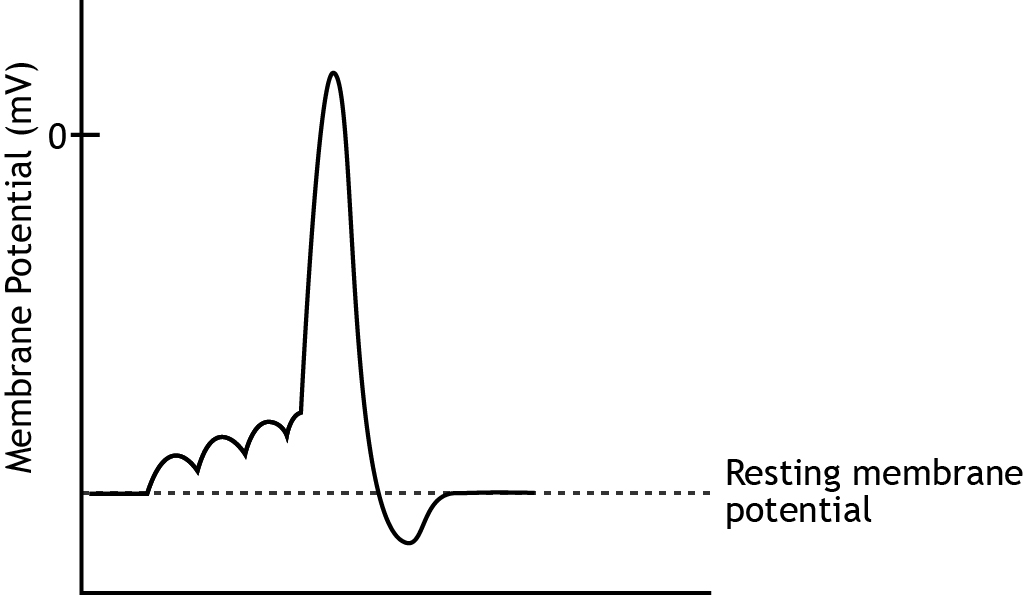
Every bit covered in Chapter 1, the action potential is a very cursory alter in the electrical potential, which is the departure in charge between the within and outside of the jail cell. During the action potential, the electrical potential beyond the membrane moves from a negative resting value to a positive value and back.
Propagation
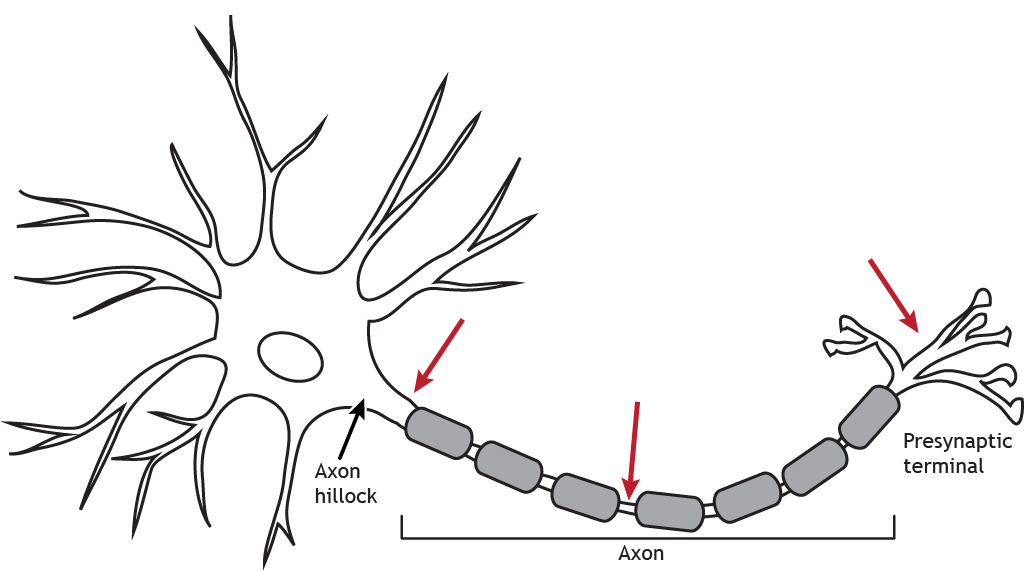
The propagation of the action potential from the axon hillock downward the axon and to the presynaptic terminal results in release of chemical neurotransmitters that communicate with a postsynaptic neuron.
Animation 6.1. The activity potential moves downward the axon kickoff at the axon hillock. The action potential moving down a myelinated axon will jump from one Node of Ranvier to the next. This saltatory conduction leads to faster propagation speeds than when no myelin in present. When the activity potential reaches the synaptic terminal, it causes the release of chemical neurotransmitter. 'Activity Potential Propagation' by Casey Henley is licensed under a Creative Commons Attribution Non-Commercial Share-Alike (CC-BY-NC-SA) 4.0 International License. View static prototype of animation.
Voltage-Gated Ion Channels
The change in membrane potential during the action potential is a function of ion channels in the membrane. In the previous lessons, we have learned nearly the principles of ion movement and accept discussed not-gated (leak) channels at balance, every bit well every bit ion channels involved in the generation of postsynaptic potentials. In this chapter, we will examine a dissimilar blazon of ion channel: voltage-gated ion channels. For our purposes, these channels are located primarily at the axon hillock, along the axon and at the terminal. They are necessary for the propagation of the action potential.
Voltage-gated channels allow ions to cross the membrane using the aforementioned ion move principles covered in previous lessons. The main difference between voltage-gated channels and leak channels are how they are opened or "gated". Voltage-gated channels open up when the cell'southward membrane potential reaches a specific value, called threshold. The neuron reaches threshold after enough EPSPs calculate together.
Animation 6.2. As EPSPs summate, a result of ion movement not shown in the animation, the prison cell'southward membrane potential will depolarize. Reaching threshold causes voltage-gated ion channels to open. Once the channels are open, ions volition move toward equilibrium. In the blitheness, sodium ions flow inward. The dotted, blueish channels represent voltage-gated sodium channels; the striped, light-green channels represent voltage-gated potassium channels; the solid yellow channels represent chloride channels. 'Voltage-Gated Channel' by Casey Henley is licensed under a Creative Eatables Attribution Not-Commercial Share-Alike (CC-BY-NC-SA) iv.0 International License. View static image of animation.
The Action Potential
The action potential begins when the cell's membrane potential reaches threshold. Once initiated in a good for you, unmanipulated neuron, the activity potential has a consequent structure and is an all-or-nothing event. It volition run through all the phases to completion.
The rising phase is a rapid depolarization followed by the overshoot, when the membrane potential becomes positive. The falling phase is a rapid repolarization followed by the undershoot, when the membrane potential hyperpolarizes past rest. Finally, the membrane potential will return to the resting membrane potential.

Rising Phase
The rising phase is caused by the opening of voltage-gated sodium channels. These ion channels are activated once the cell's membrane potential reaches threshold and open immediately. The electrochemical gradients bulldoze sodium into the cell causing the depolarization.
Blitheness 6.3. Voltage-gated sodium channels open up once the cell'due south membrane potential reaches threshold. The rapid influx of sodium results in a large depolarization chosen the rising phase. The dotted, blueish channels correspond voltage-gated sodium channels; the striped, green channels represent voltage-gated potassium channels; the solid yellow channels represent chloride channels. 'Rising Stage' by Casey Henley is licensed under a Creative Eatables Attribution Non-Commercial Share-Alike (CC-Past-NC-SA) 4.0 International License. View static paradigm of animation.
Falling Phase
The falling stage of the activeness potential is caused by the inactivation of the sodium channels and the opening of the potassium channels. After approximately 1 msec, the sodium channels inactivate. The aqueduct becomes blocked, preventing ion flow. At the same time, the voltage-gated potassium channels open. This allows potassium to rush out of the cell because of the electrochemical gradients, taking its positive accuse out of the cell, and repolarizing the membrane potential, returning the cell's membrane potential back near rest.
Similar the voltage-gated sodium channels, the voltage trigger for the potassium channel is when the prison cell's membrane potential reaches threshold. The difference is that the sodium channels open up immediately, whereas the potassium channels open up later on a filibuster.
Blitheness 6.4. After approximately 1 msec, the voltage-gated sodium channels inactivate, which prevents any further ion flow into the cell. Although the voltage-gated potassium channels are activated in response to the cell reaching threshold, their opening is delayed and occurs alone with the sodium channel inactivation. This allows an efflux of potassium ions, which causes the repolarization of the falling phase. The dotted, blue channels represent voltage-gated sodium channels; the striped, light-green channels represent voltage-gated potassium channels; the solid yellow channels represent chloride channels. 'Falling Phase" past Casey Henley is licensed under a Creative Commons Attribution Non-Commercial Share-Akin (CC-Past-NC-SA) iv.0 International License. View static paradigm of animation.
Undershoot
As the membrane potential returns to resting level, the sodium channels will de-inactivate, returning to the airtight position, ready to exist opened by a voltage change over again. The potassium channels will also close, just they remain open long enough to crusade a hyperpolarizing undershoot as potassium continues to movement toward its equilibrium potential of -80 mV.
Animation 6.5. Once the cell's membrane potential repolarizes, the voltage-gated sodium channels de-inactivate and return to their airtight land. The voltage-gated potassium channels remain open up long enough for the undershoot to occur as potassium continues to flow out of the prison cell. The dotted, blue channels represent voltage-gated sodium channels; the striped, green channels represent voltage-gated potassium channels; the solid yellow channels represent chloride channels. 'Undershoot' by Casey Henley is licensed nether a Creative Eatables Attribution Non-Commercial Share-Akin (CC-BY-NC-SA) 4.0 International License. View static image of animation.
Return to Rest
Once the voltage-gated channels close, the sodium-potassium pumps will reestablish the proper ionic concentrations needed for the electrochemical gradients. This activity along with open leak channels volition return the jail cell to its resting membrane potential.
Animation 6.half dozen. Once the voltage-gated potassium channels close, the sodium-potassium pump volition work to re-establish the electrochemical gradients and return the cell to its resting membrane potential. 'Return to Rest' by Casey Henley is licensed under a Creative Eatables Attribution Non-Commercial Share-Alike (CC-Past-NC-SA) 4.0 International License. View static paradigm of animation.
Refractory Periods
The Absolute Refractory Period
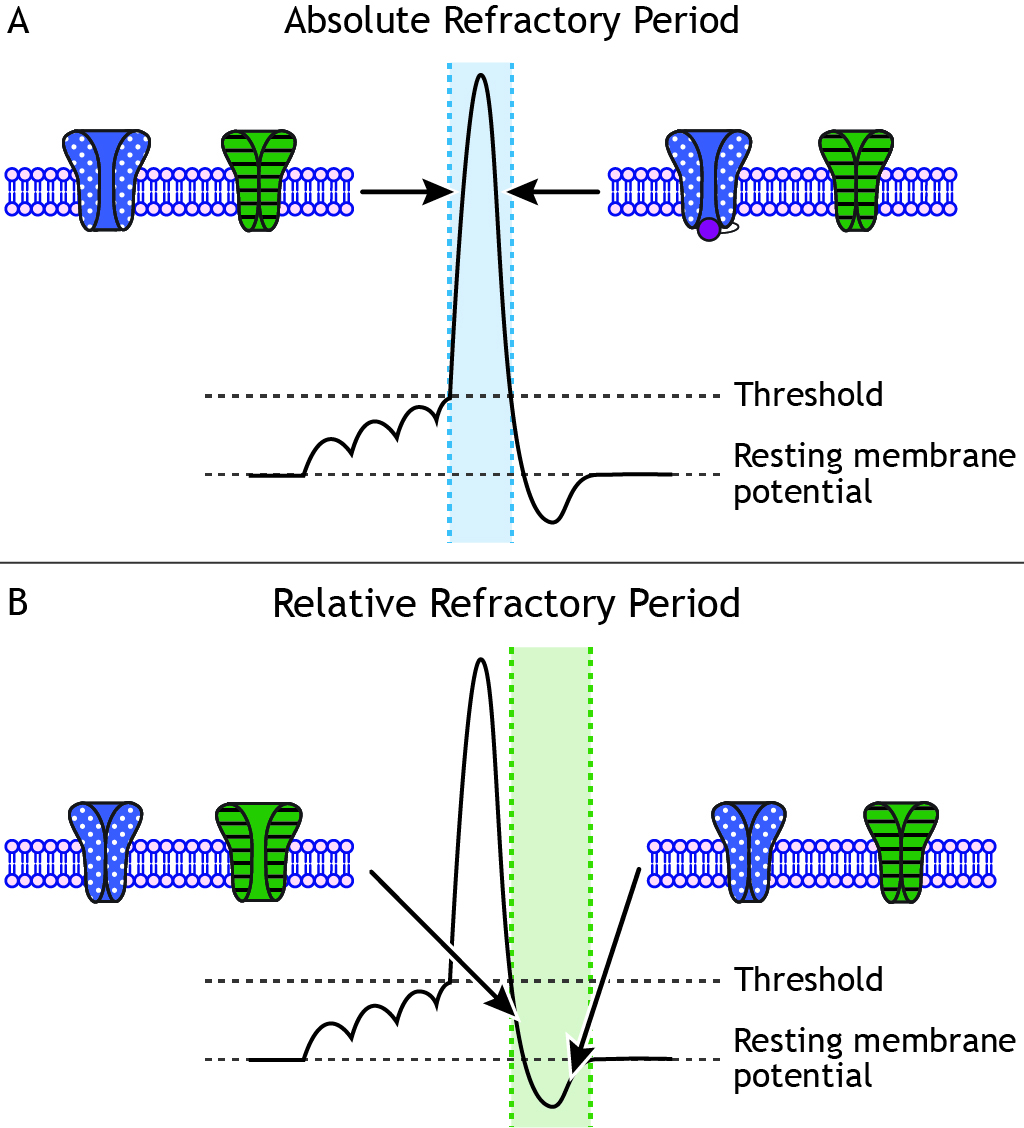
Each neuron does accept a maximum firing charge per unit. And fifty-fifty if the stimulus continues to increase in strength, the neuron cannot fire at a college frequency. The maximum firing rate of a jail cell is determined by the status of the ion channels in the neuronal membrane during the different phases of the action potential. During the absolute refractory period, a second activity potential cannot be fired under any circumstances regardless of the forcefulness of the stimulus. The voltage-gated sodium channels are either open (during the rising stage) or inactivated (during the falling phase).
The Relative Refractory Period
When the jail cell repolarizes and the voltage-gated sodium channels de-inactivate and return to a closed state, the cell is again able to fire another activity potential. Nevertheless, during the end of the falling phase and the during the undershoot, voltage-gated potassium channels are still open. During the undershot, while the neuron is hyperpolarized, a larger-than-normal stimulus is needed to make the cell accomplish threshold again. This segment of the action potential is called the relative refractory flow. Action potentials can be fired, merely a stronger stimulus is needed than when the cell is at rest.
Activeness Potential Characteristics
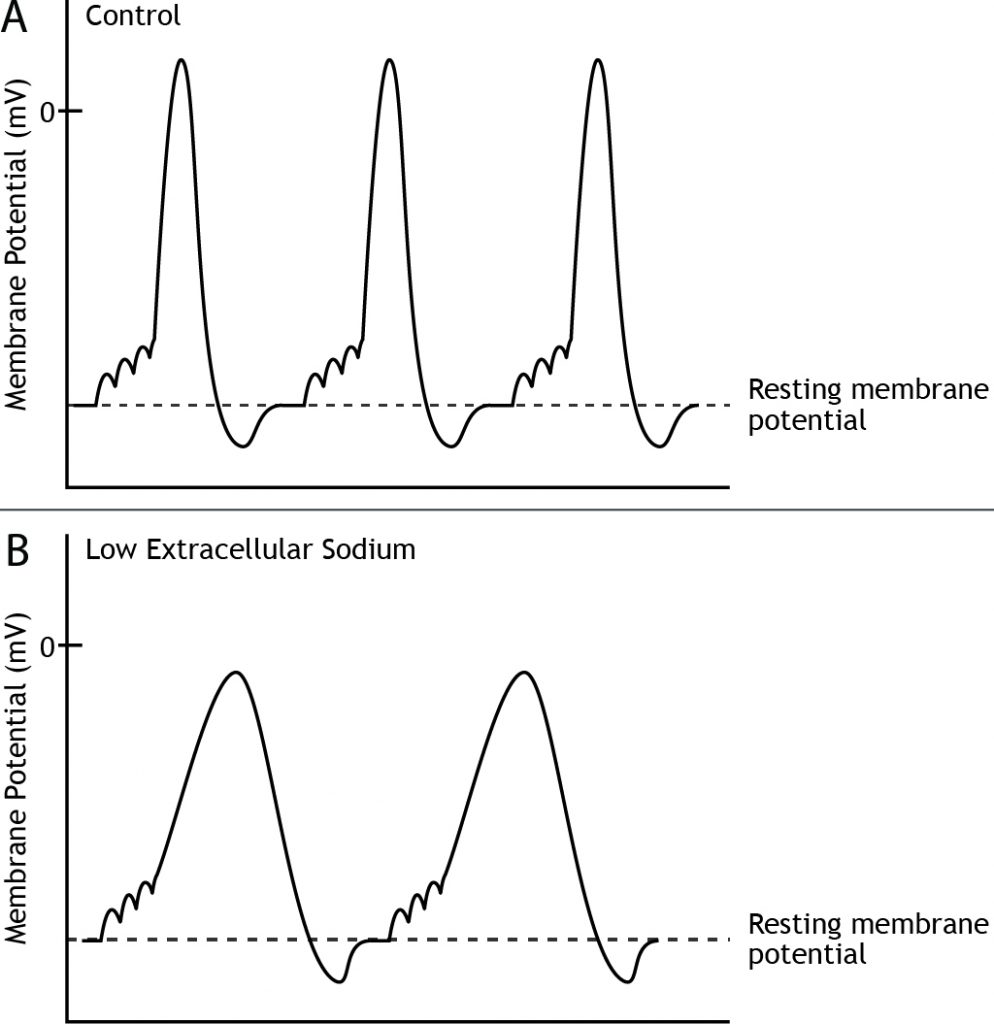
For a given cell, all activeness potentials have the same characteristics; they depolarize to the same membrane potential value and take the same amount of time. Notwithstanding, different neurons may exhibit different action potential characteristics. As well, if a neuron has a change in its environment, similar altered extracellular ion concentrations, the shape of the action potential would change due to a change in the electrochemical gradients. For instance, if the external concentration of sodium is decreased, the equilibrium potential of sodium, likewise as the strength of the electrochemical gradients will change, which will effect in a slower rate of rise and a lower amplitude of the action potential.
Stimulus Strength
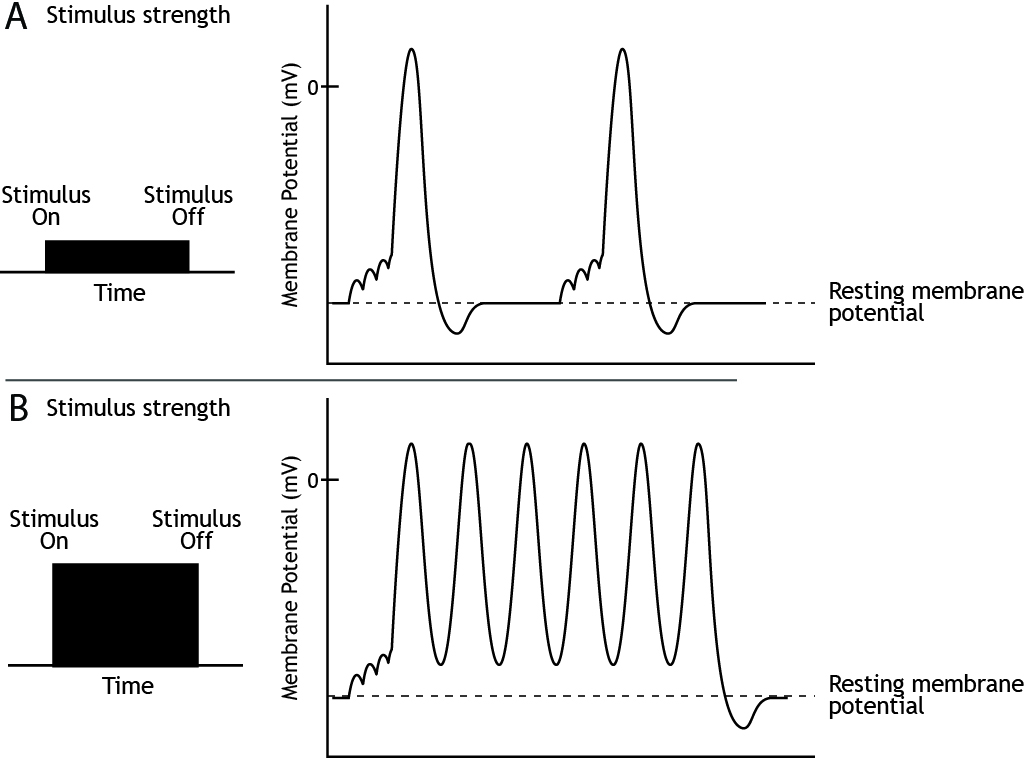
The forcefulness of a stimulus needs to be encoded by the neurons. We need to be able to perceive the departure, for example, betwixt a dim light and a bright one. The frequency or rate of activity potential firing informs the nervous system of stimulus strength.
Since the height of the action potential is always the aforementioned for a given neuron, the strength of the stimulus is adamant past the frequency of action potential firing. A weak stimulus would cause fewer action potentials to be fired than a strong stimulus.
Direction of Propagation
The action potential moves down the axon due to the influx of sodium depolarizing nearby segments of axon to threshold.
Animation 6.7. A voltage change that reaches threshold volition cause voltage-gated sodium channels to open in the axonal membrane. The influx of sodium causes the rising phase of the activity potential, but the ion flow also depolarizes nearby axon regions. Every bit the depolarization reaches threshold, the action potential moves down the axon. The dotted, blueish channels represent voltage-gated sodium channels; the striped, greenish channels stand for voltage-gated potassium channels. 'Action Potential Motion' by Casey Henley is licensed under a Creative Eatables Attribution Non-Commercial Share-Akin (CC-BY-NC-SA) iv.0 International License. View static epitome of animation.
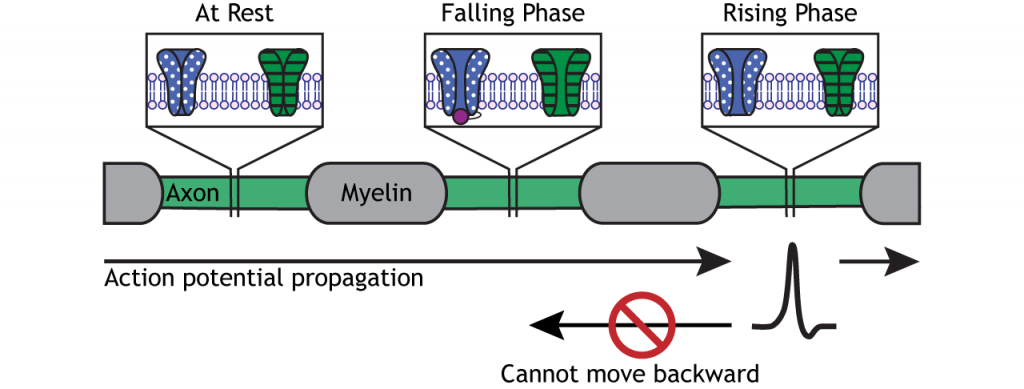
Action potentials only movement in i direction, though, from the prison cell body to the presynaptic terminal. The refractory period keeps the action potential from moving backward downwardly the axon. As the action potential moves from ane Node of Ranvier to the next, the inactivated sodium channels in the previous axon segment prevent the membrane from depolarizing again. Therefore, the activeness potential tin can merely move forward toward axon segments with closed sodium channels gear up for rise phase depolarization.
Speed of Propagation
Presence of Myelin
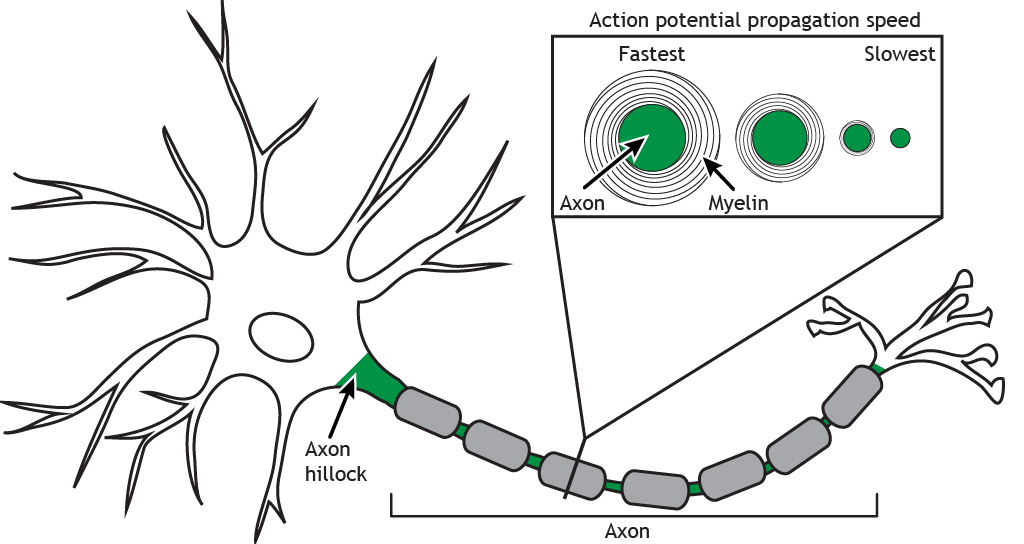
The presence of myelin leads to a significant increase in activeness potential conduction speed compared to an unmyelinated axon. For a myelinated axon, the action potential "jumps" betwixt Nodes of Ranvier in a procedure chosen saltatory conduction. The nodes have a high density of voltage-gated channels, and the activeness potential is able to skip the axon segments covered by the myelin. In an unmyelinated axon, the activeness potential moves in a continuous wave. In additional to the saltatory conduction process, the presence of myelin also insulates the axon, preventing accuse loss across the membrane, which also increases speed of the action potential.
Animation six.8. The activeness potential moves downwardly an unmyelinated axon similar a wave, opening voltage-gated channels along the length of the axon. In a myelinated axon, though, the action potential is able to skip portions of the axon that are covered by the myelin; the activity potential jumps from node to node and travels further down the axon in the aforementioned amount of time. The dotted, blue channels represent voltage-gated sodium channels; the striped, green channels represent voltage-gated potassium channels. 'Activeness Potential Speed' by Casey Henley is licensed under a Creative Eatables Attribution Non-Commercial Share-Alike (CC-By-NC-SA) 4.0 International License. View static prototype of blitheness.
Bore of Axon
The diameter of the axon too affects speed. The larger the diameter of the axon, the faster the propagation of the action potential down the axon. A larger axon leads to less resistance confronting the flow of ions, so the sodium ions are able to move more speedily to cause the regeneration of the action potential in the next axon segment.
- The voltage-gated ion channels are located along the axon hillock and axon; they open in response to the membrane potential reaching a threshold value
- The ascension phase of the activeness potential is a consequence of sodium influx
- The falling phase of the activity potential is a result of potassium efflux
- Action potentials are all-or-none (postsynaptic potentials are graded)
- Action potential have the same elevation of depolarization for a given prison cell nether typical conditions
- The neuron cannot fire a second action potential during the absolute refractory stage
- The neuron can burn a second action potential during the relative refractory phase, only information technology requires a stronger stimulus than when the neuron is at remainder
- Stimulus strength is coded by frequency of action potential firing
- Action potential travel in one management due to the presence of inactivated voltage-gated sodium channels
- Speed of propagation relies on presence and thickness of myelin and diameter of axon
Test Yourself!
Video Lecture
ericksonthicale1951.blogspot.com
Source: https://openbooks.lib.msu.edu/neuroscience/chapter/action-potentials/
0 Response to "To start an action potential moving down the axon, what must happen?"
Post a Comment