Django Unchained Leonardo Dicaprio Art Collection Painting Mean Cig
Facts You Might Not Know About Django Unchained
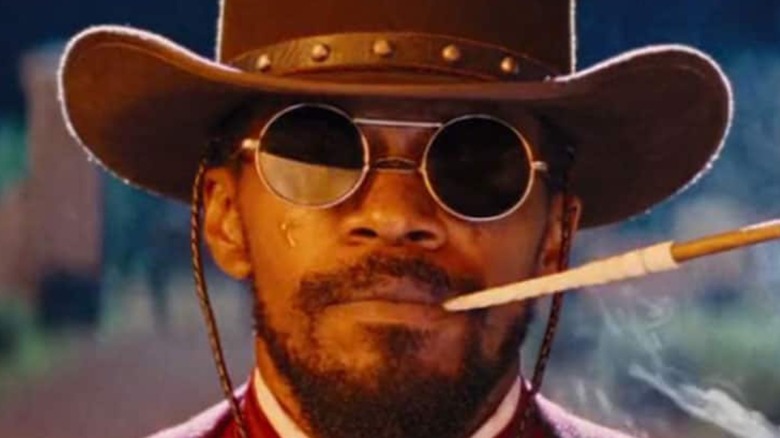
The Weinstein Company
One of the most critically acclaimed and successful directors of all time, Quentin Tarantino is one of the few true auteurs in Hollywood. Most every film in his oeuvre has been lauded past fans and critics alike, exploring a wide range of themes and ideas across genres that include crime drama, black comedy, and even Spaghetti Western. Wielding graphic violence, night humour soundtrack needledrops and memorable quotes like brilliant paints splattered across a canvas, he has developed many hallmarks of his way — and they all came together brilliantly in his biggest box-office hit (so far), 2012'southward "Django Unchained."
Featuring Jamie Foxx alongside Tarantino regulars Christoph Flit, Leonardo DiCaprio, and Samuel L. Jackson, the picture charts the story of former slave Django (Foxx) subsequently he is freed and joins with Dr. Rex Schultz (Waltz) as a compensation hunter on a quest to detect his married woman. Not only did the movie gross more than $400 million at the box office, but it also received a number of awards and nominations from the Academy Awards, Golden Globes, and BAFTA.
Tarantino fans love to spotter his films again and again — but no thing how many times you lot've seen "Django Unchained," there are many hidden secrets and Easter eggs you likely missed. With that in mind, here are some little-known facts from Tarantino's revisionist Western that might surprise you.
Leonardo DiCaprio Genuinely Cut His Mitt Open up During A Scene
The Weinstein Company
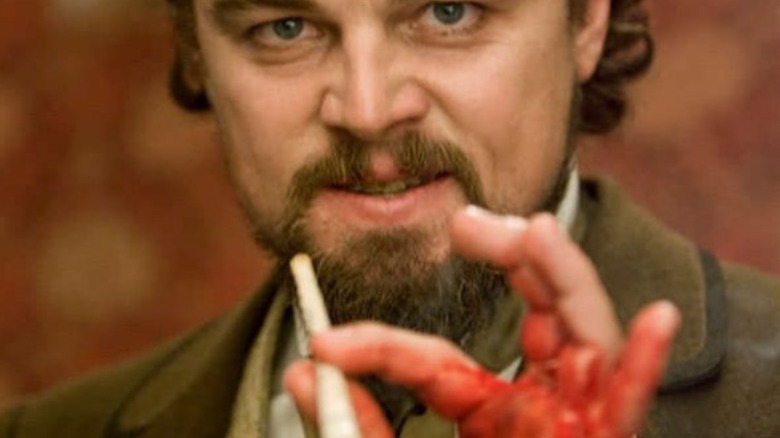
In a pivotal scene most the terminate of the film, Calvin Candie (DiCaprio) is explaining the pseudoscience of phrenology afterwards discovering that Django and Schultz are attempting to trick him into releasing Broomhilda (Kerry Washington). In his anger, the character smashes his hand on a table.
In real life, DiCaprio accidentally sliced his hand open on a small slice of broken drinking glass during the take you see in the movie. Despite his bleeding mitt, the player continued with the scene.
"Leo had slammed his hand on the table endless times and he moved his hand farther and he crushed a crystal cordial drinking glass," producer Stacey Sher told Variety in 2012. "Blood was dripping down his hand. He never broke graphic symbol. He kept going. He was in such a zone. Information technology was very intense. He required stitches."
Co-ordinate to Sher, when the scene was over, the bandage and crew gave him a standing ovation.
"Not considering he cut himself," Sher explained. "Considering in that scene he had pages and pages of monologue. His performance was masterful. His level of commitment is extraordinary."
Plain, the shocking sight of claret resulted in an intensity that Tarantino thought was ideal for the scene. That, in plough, inspired a moment later in the scene where we meet Candie wipe blood on Broomhilda'due south face. This story beat was filmed separately, however, allowing for fake claret to be employed.
Will Smith Turned Down The Chance To Play Django
Andrea Raffin/Shutterstock
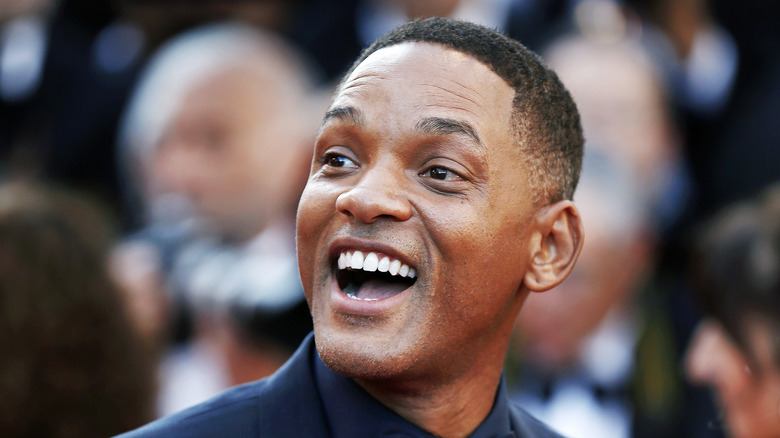
When Tarantino was writing the script for "Django" he had a number of actors in mind; at the front end of the pack was Will Smith, who he met up with in New York while the A-lister was filming "Men in Black Iii," eager to discuss the possibility — but was turned downwardly.
"I've e'er avoided making films about slavery," Smith told GQ in 2021, partially explaining his conclusion. "In the early on part of my career ... I didn't want to bear witness Black people in that light. I wanted to be a superhero. Then I wanted to depict Blackness excellence alongside my white counterparts. I wanted to play roles that y'all would requite to Tom Prowl."
In a 2015 interview with The Hollywood Reporter, Smith addressed "Django" itself. "Information technology was virtually the artistic management of the story. To me, it's as perfect a story every bit you could ever want: a guy that learns how to kill to retrieve his wife that has been taken every bit a slave. That idea is perfect. And it was merely that Quentin and I couldn't meet [centre to eye]," he explained. "I wanted to make that movie then badly, only I felt the only way was, it had to be a love story, not a vengeance story."
After he passed, Tarantino put several other name actors through his unique casting process before settling on Foxx.
"I met six different actors and had extensive meetings with all of them, and I went in-depth on all of their work," Tarantino told Playboy in 2012. "Idris Elba, Chris Tucker, Terrence Howard, Michael K. Williams and Tyrese. They all appreciated the textile, and I was going to put them through the paces, brand them go off against one another and put up an obstacle course. And then I met Jamie and realized I didn't need to do that."
Controversial Django Unchained Activeness Figures Were Pulled
Django Unchained toys/Hollywood Reporter
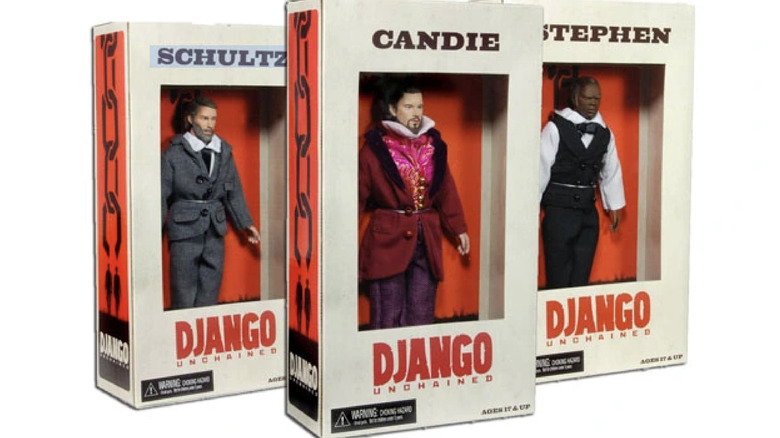
Following the film's release, National Entertainment Collectibles Clan began producing a serial of 6 action figures based on "Django" characters — Django, Broomhilda, Dr. Rex Schultz, Calvin Candie, Stephen, and Butch Pooch dolls, each costing about $30 at retail.
While collectors' toys have fabricated activity figures out of R-rated films for decades, the "Django" themes of slavery and extreme violence didn't help the crusade. The National Action Network and Project Islamic Promise both announced boycotts for the collectibles, condemning them every bit offensive; others criticized the action figures for making play toys nigh slavery.
"Selling this doll is highly offensive to our ancestors and the African-American community," Rev. K.W. Tulloss of the National Activeness Network said to the NY Daily News. "The motion picture is for adults, but these are action figures that appeal to children. Nosotros don't want other individuals to utilize them for their entertainment, to make a mockery of slavery."
Soon after the controversy began making headlines, The Weinstein Company asked that production of the dolls be stopped — as Christoph Waltz told TMZ. Some one thousand dolls had already been sent to stores earlier the cancellation, though, allowing fans to get ahold of them. Yous can currently find them on sale sites like eBay, where they announced to be selling for several hundred dollars each.
Jamie Foxx Rode His Own Horse In The Film
The Weinstein Company
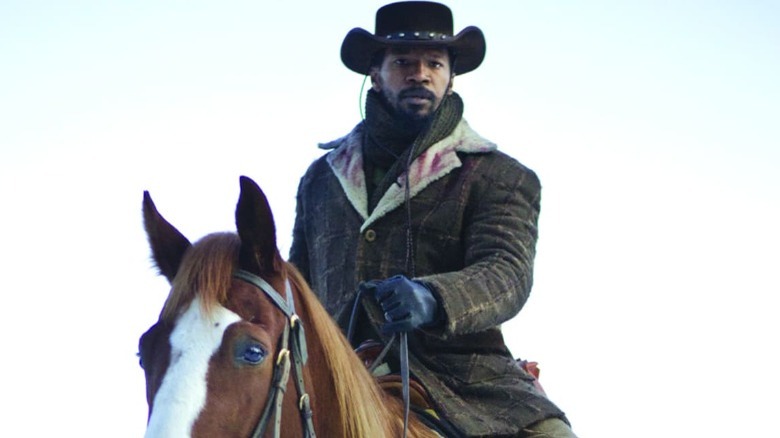
Before landing "Django," Foxx was already an accomplished horse rider and owner of several steeds. Four years before filming the movie, Foxx had been given a horse named Cheetah equally a birthday present, which he subsequently learned to ride.
"I always say cracking projects similar [Django] parallel your life," he told Total Film in 2012. "About four and a half years ago, I got a equus caballus for my birthday and I started riding, and the next thing you lot know, I run into this cinematic genius, I telephone call him, 'Quentin Tarantino.' He says he has a Western and I said, "Well, I happen to have my own horse ... like I said, great things similar that happen."
Chetah was renamed "Tony" in the film, and gave a wonderful, regal functioning. Despite Foxx doing the occasional rodeo, he still found some moments terrifying while filming. At one point he had to ride without a saddle, with the horse galloping at 28 miles per hour. Things got worse when Tarantino needed some other take, forcing Foxx to become through the frightening ordeal once more.
Tarantino Cut Back On Some Violent Scenes
The Weinstein Visitor
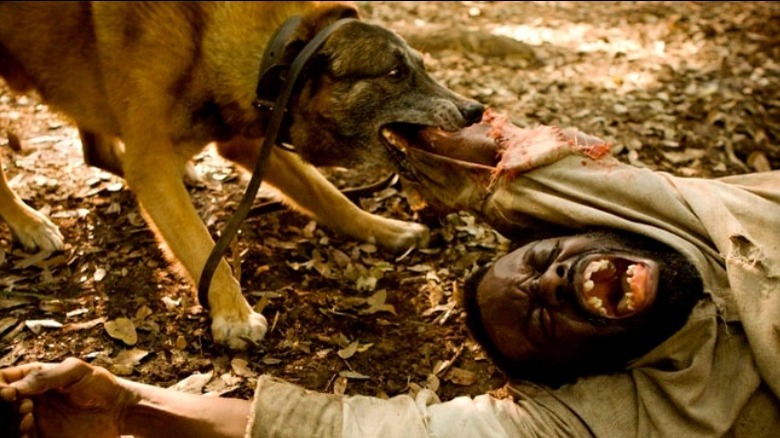
Tarantino's movies are, of course, well known for their stylized, often brutal violence. Movies such as "Inglourious Basterds" contain horrific acts of torture, maiming, and savage deaths, "Reservoir Dogs" has the ear scene, "Pulp Fiction" has the scene in the pawn shop, and the Crazy 88 sequence from "Kill Bill" is itself a study in how to make violence wait both hauntingly gory and hypnotically balletic. And then, it didn't come up as a huge surprise when "Django" displayed significant savagery through much of its runtime. Yet, the violence in the Western might have been a lot worse, if Tarantino hadn't decided to pull back on some of his more extreme inspirations — largely considering he didn't want to traumatize the audition too much.
"It had to be modulated, and it was something that was done through editing. There'due south a painful department in the pic: Information technology's most like, Django and Schultz going to the gates of hell. When they enter Greenville and pretty much until they get to Candyland, those are the iii rings of hell they accept to pass through," he said to Grantland in 2012. "Initially the sequence with the mandingo fight was even stronger than it is now, and the scene with the dogs was fifty-fifty tougher. There's a agglomeration of unlike emotions that I'yard trying in this movie: one-act, activeness, suspense, and ultimately a big triumph. And when I watched it with an audience I realized that I had traumatized them too much to go where I needed them to go. It'southward like I cutting their heads off. They grew some other caput, simply they were still a lilliputian too traumatized to cheer with the vigor and gusto that I wanted them to. I had to modulate the sequences back."
Nevertheless, Tarantino told The Wrap that same yr that because of the unfortunate truths of slavery, going further would likely have been more authentic.
Original Django Actor Franco Nero Has A Cameo
The Weinstein Company
Tarantino is a big fan of Italian managing director Sergio Corbucci and many of his Spaghetti Westerns were important influences for "Django Unchained." One moving picture, in item, was influential and that was the 1966 motion-picture show "Django." This moving-picture show starred Franco Nero equally the title grapheme, with him seeking revenge for the murder of his former lover. This was the role player's breakthrough role and established him every bit a star in both Hollywood and Italy.
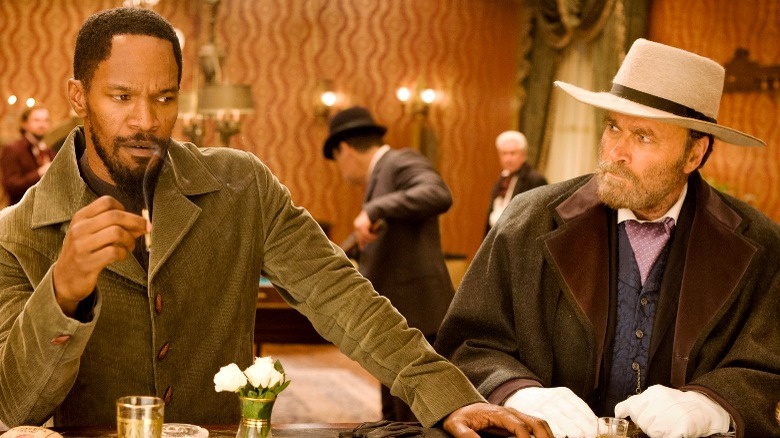
In a nod to the original "Django" and the actor himself, Nero has a brief cameo in "Unchained." During the bar scene when Django and Schultz offset encounter with Candie, Foxx'southward character drinks and talks with a man. This mysterious man asks what Django's name is and he confirms it before saying that "The D is silent." Nero's character replies with "I know" before walking off. Information technology's a small part, simply a clever tribute to the moving picture's Spaghetti Westerns antecedents.
A Django/Zorro Crossover Comic Was Created
DC Comics
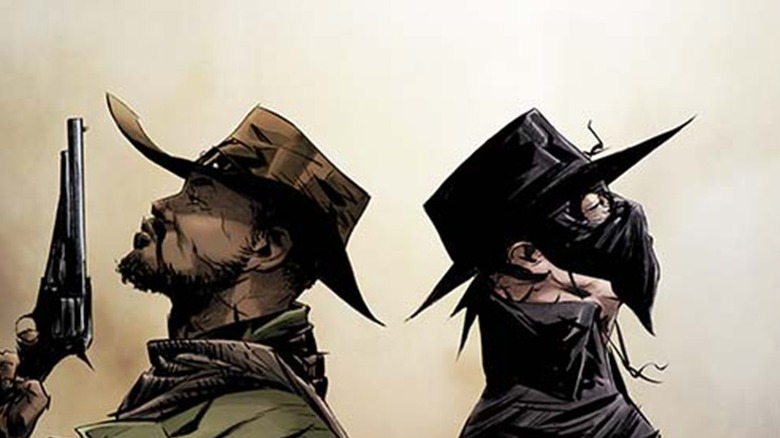
In the wake of "Django Unchained," in that location was clamor for more tales from these characters, and even some talk of a potential sequel. With Tarantino stating publicly on repeated occasions that he'll only be making one more flick, it seems highly unlikely at this signal that it would revisit "Django"; the director did, however, team upwardly with animator Matt Wagner in 2014 to write a series of comics telling the story of Django some x years after the events of the movie.
In the story, he meets up with none other than the legendary masked fighter Zorro, teaming upwards with the masked man.
"Django/Zorro" ran for seven issues in total and proved something of a cult striking. It was released as a joint venture between Dynamite Entertainment and DC Comics. In contempo years there take been suggestions that a potential motion picture based on the comics could be made, with Tarantino taking a part in writing and producing the project. Whether Foxx would return to one time once again portray Django is unknown — and Tarantino seems unlikely to go anywhere near Zorro while friend/frequent collaborator Robert Rodriguez is overseeing a gender-swapped TV series nigh the character.
Jamie Foxx Gave Christoph Flit A Special Saddle
The Weinstein Company
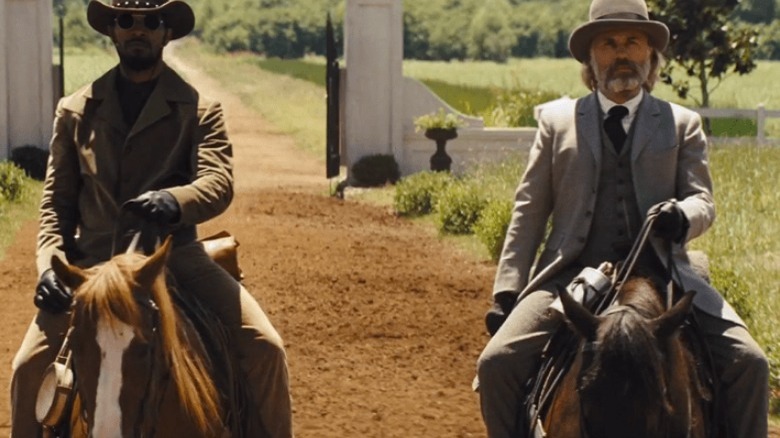
Like many Westerns, "Django Unchained" features a lot of equus caballus riding. Django and Schultz are often seen on horseback, using their trusty steeds to get effectually as they collect bounties. While stuntmen did some of the riding, it was necessary for Foxx and Waltz to go on the horses oft for filming purposes. But while Foxx had his riding experience to autumn back on, the same wasn't truthful of Flit, who admitted he was initially agape of getting on the horse during filming.
"Information technology was not only uncomfortable, I acknowledge I was a footling scared. A horse is very big and I'm sort of a regular person," Waltz told Conan O'Brien on a 2012 episode of "Conan." "So the outset amble, the first gallop, I was afraid of. But so I had these wonderful teachers and trainers and friends helping me, supporting me."
While preparing for the office, Waltz roughshod from a horse on set, breaking his pelvis and requiring a plate and screws to recover. Equally a joke souvenir when he returned to prepare, Foxx gave Waltz a special saddle.
"[Foxx gave me] a big beautiful saddle and there was a seatbelt on with a buckle and everything," he explained, adding that he'll always carry with him a reminder of his "Django" chance. "I got a plate and screws, the works. I'm bionic ... now, I beep at airports."
Calvin Candie Is The Just Villain Quentin Tarantino Actually Hates
The Weinstein Company
One thing common throughout all of Tarantino'due south movies is that at that place is always at to the lowest degree one actually vicious bad guy. In fact, many of his films feature multiple villains who can give the worst of the worst from Hollywood a run for their money. There'due south Hans Landa (Christoph Waltz) from "Inglourious Basterds," Bill (David Carradine) from the "Kill Bill" series, Daisy Domergue (Jennifer Jason Leigh) from "The Hateful Viii," and Marsellus Wallace (Ving Rhames) was "Pulp Fiction." While each of them is reprehensible and evil in their own means, they all have some redeeming qualities or justification for what they do.
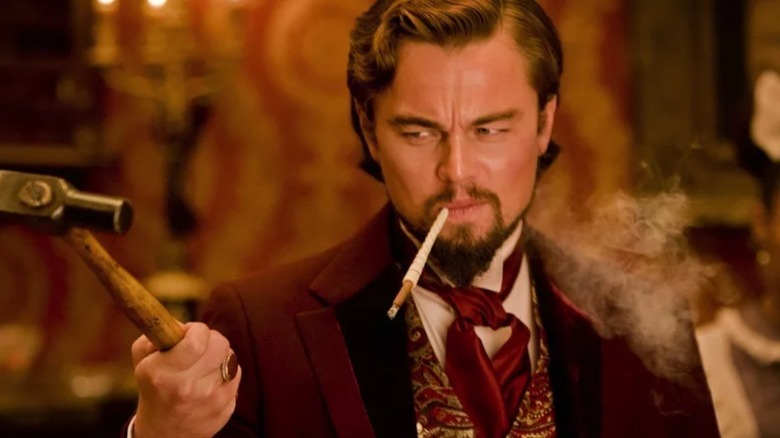
That isn't the case with Calvin Candie — at least not according to Tarantino himself. Speaking in Playboy, the director said that Candie is "the kickoff villain I've e'er written that I didn't similar." He went on to explain that he "hated Candie" and "normally like[s] my villains no matter how bad they are." It seems like the character inspire hatred in both viewers and filmmakers.
Frank Sea Wrote A Carol For The Film
DFree/Shutterstock
Like many other Tarantino films, "Django" features an original score mixed with existing music. Part of this is considering the director feels uneasy almost giving one person responsibility for creating the entire soundtrack. Speaking in 2009, Tarantino said: "I just don't similar the idea of giving that much ability to anybody on one of my movies. I would much rather work with a music editor than a music composer." The moving picture features a mix of classical music, original tracks from the legendary Ennio Morricone, and popular music from the likes of James Brown and 2Pac.
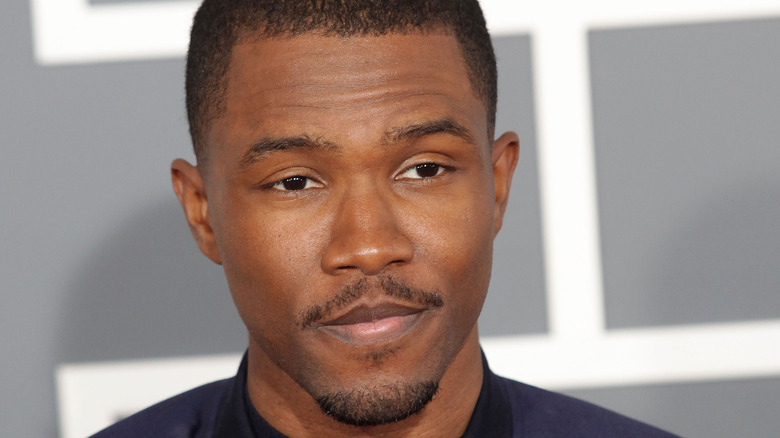
"Django Unchained" was set to feature a carol from Frank Body of water. The musician went equally far as writing and recording the song, but Tarantino rejected it when he couldn't find a place to include the track in the flick. He later released a statement explaining what had happened, maxim that "Frank Ocean wrote a fantastic ballad that was truly lovely and poetic in every way, there merely wasn't a scene for it."
Django's Glasses Are Based On Those Worn By Charles Bronson
The Weinstein Company
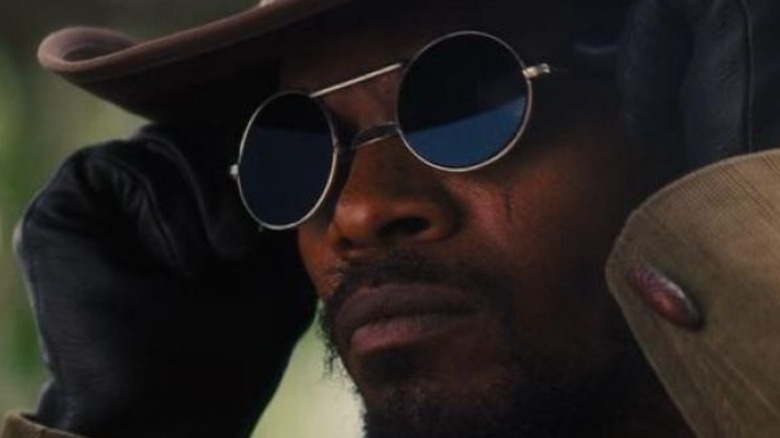
As a Spaghetti Western, "Django Unchained" had a lot of influences from classic Westerns, including shows such as "Bonanza." Costume designer Sharen Davis worked with Tarantino to examine old films and television series to get ideas for the kind of outfits that the characters in the film should wear. Equally the protagonist, getting the look of Django was arguably the about important attribute of the costume design and the pair settled on a "rock-north-curlicue accept on the character" co-ordinate to Davis.
One of the big influences for Django's costume was from a painting chosen "The Blue Boy." This artwork was created by Thomas Gainsborough and inspired the distinctive blueish valet costume that Django chooses for himself. His sunglasses, meanwhile, were based on the ones worn by Charles Bronson's character in the fantasy western film "The White Buffalo." Inspiration for other costumes came from "Blood for a Silvery Dollar," "Miami Vice," and "Kojak."
Jonah Hill Almost Had A Much Bigger Office
The Weinstein Company
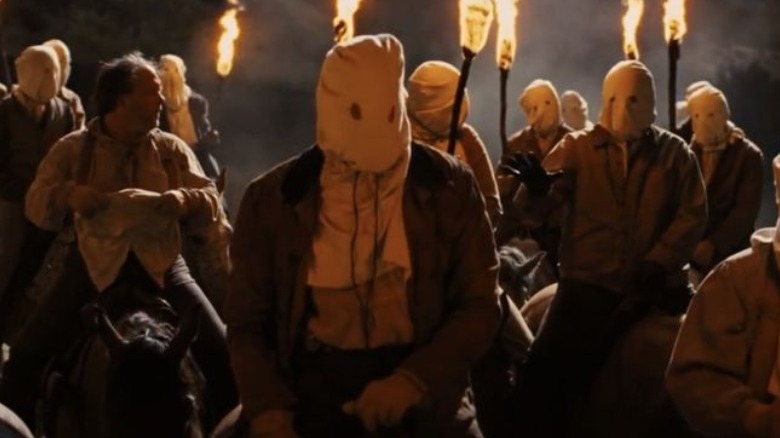
Those who have seen "Django" might recall a brief cameo from Jonah Hill. The role player plays a bumbling member of the Ku Klux Klan who attempts to kill Django and Schultz at night in an ambush with his begetter and workers. Hill met with Tarantino in 2010 afterwards the director had made positive comments about the film "Cyrus." The role player thanked Tarantino at an honor bear witness and the two got talking nearly the possibility of Hill appearing in a future pic.
Despite like-minded to accept the part, Loma nigh had to dorsum out of the project completely because of scheduling conflicts. Only the director was able to switch some dates around to ensure that the actor would be able to announced later receiving a letter from him. Hill after explained: "I wrote him a alphabetic character maxim how sad I was, which ended up moving him to move the dates for me because he was moved by my alphabetic character, that was very personal, about how much his films mean to me."
The audience might have been treated to an fifty-fifty bigger role from Hill if things had gone to plan. Tarantino had originally intended to include a storyline explaining how Broomhilda had ended up in the possession of Candie. This would have involved a character named Scotty Harmony who would lose her in a card game to the villain. Both Hill and Sacha Baron Cohen were considered for the part, but the scenes were cutting as they negatively impacted the period of the film.
Tarantino Considers The Movie A Prequel To Shaft
The Weinstein Company
"Shaft" is a classic of the blaxploitation genre, making a star out of Richard Roundtree and offering 1971 audiences the extremely rare opportunity of seeing an unapologetic Blackness homo kicking butts, romancing women, and by and large sticking it to the man. After Roundtree revisited the graphic symbol for a couple sequels, the original flick was remade in 2000 starring Samuel L. Jackson in the title function, and in 2019 a sequel cast Jackson and Roundtree alongside Jessie T. Conductor, telling a tale of three generations of Shafts risking heir necks for their brother man.
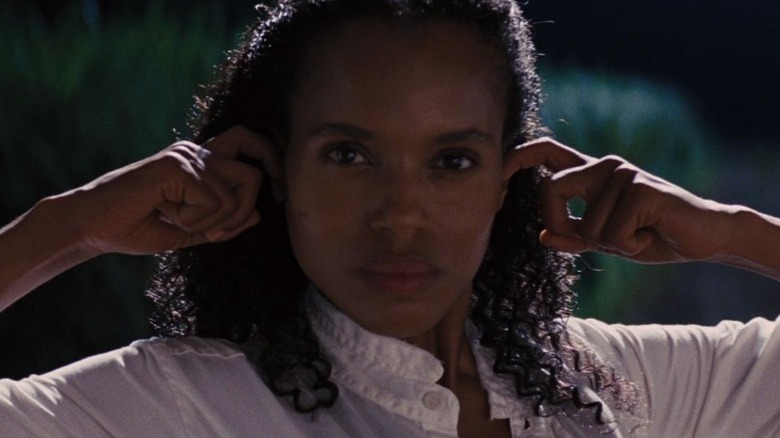
What does this have to practise with "Django"? When Tarantino was promoting the motion-picture show in 2012 at Comic-Con, he mentioned that he considers his slave revenge tale to exist a quasi-prequel to "Shaft."
According to a Deadline report: "[Tarantino] says Kerry Washington'due south grapheme [Broomhilda] von Shaft is, in his mind, an ancestor of John Shaft — [which then] prompted QT to start singing the theme song out loud."
Kerry Washington and Jamie Foxx Have Played A Married Couple Before
The Weinstein Company
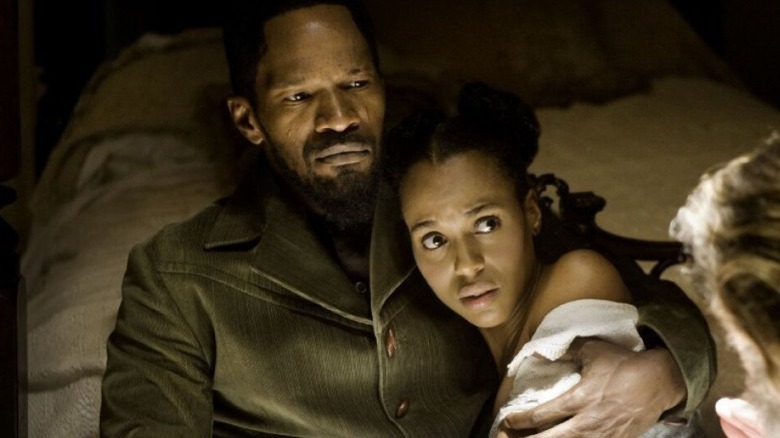
Kerry Washington and Jamie Foxx play Broomhilda and Django in "Django Unchained," the two lovers who are separated equally slaves afterwards they effort to escape from their previous master. The honey story between them is central to what happens across the entire picture show, and finding her once again is what motivates Django to bring together with Schultz and become a compensation hunter. The two share a great chemistry and make a believable couple.
Part of that is because Washington and Foxx already knew each other when it came fourth dimension to film "Django Unchained." The pair had previously worked together on "Ray," the Oscar-winning biographical movie that focused on the life of Ray Charles; Foxx played the musician while Washington portrayed his wife Della Bea Robinson.
As for their second fourth dimension together on screen, Washington praised Foxx for the support he gave her during filming, saying that she could "spend the rest of my life thanking Jamie for all the love and support he showed me in the process of making this film and it would never be enough."
ericksonthicale1951.blogspot.com
Source: https://www.looper.com/792800/facts-you-might-not-know-about-django-unchained/
0 Response to "Django Unchained Leonardo Dicaprio Art Collection Painting Mean Cig"
Post a Comment